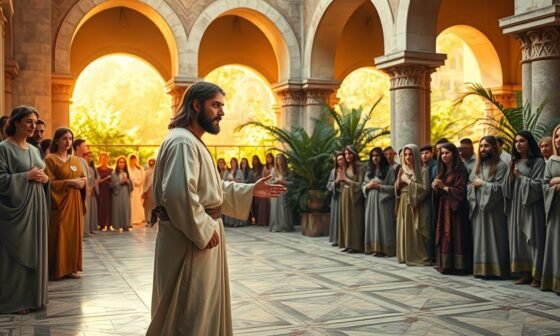
People ask about Samson for different reasons. Some remember him as the strongest man in the Bible. Others remember the hair, the betrayal, or the dramatic ending.
And many simply want a clear answer because they are reading, teaching, or reflecting and want to know where his story actually appears in Scripture.
That question is a good place to start, because Samson’s story is not scattered across the Bible. It is contained in one specific section, told carefully from beginning to end. And when you slow down and read it as a whole, it becomes more than a story about strength. It becomes a story about calling, weakness, patience, and mercy.
The story of Samson is found in the Book of Judges, chapters 13 through 16.
Those four chapters hold his birth, his calling, his choices, his failures, and his final prayer. Reading them together matters, because Samson’s life makes the most sense when it is not rushed or broken into isolated moments.
This article will walk through those chapters slowly. Not to rush to lessons, but to understand what is happening and why it matters for faith today.
The short and clear answer
If someone asks, “Where is the story of Samson in the Bible?” the simple answer is this:
Samson’s story is recorded in Judges chapters 13, 14, 15, and 16.
That is the full account. It begins before he is born and ends with his death. Everything the Bible tells us about Samson is contained there.
Judges 13 focuses on his birth and calling.
Judges 14 and 15 show his early life, strength, and growing conflict.
Judges 16 tells of his fall, his capture, and his final act.
There are later references to Samson in Scripture, but the narrative itself stays in Judges. To understand him properly, those chapters should be read as one continuous story.
Why Samson’s story is in the Book of Judges
To understand Samson, it helps to understand the book he appears in.
Judges records a difficult season in Israel’s history. The people are settled in the land, but they are spiritually restless. Over and over, the same pattern appears. The people turn away from God. Life becomes unstable. They cry out for help. God raises up a judge to deliver them. Peace returns for a while. Then the cycle repeats.
The judges were not kings, and they were not priests in the usual sense. They were leaders raised up by God to bring relief during times of trouble. Some judged wisely. Some were deeply flawed. All of them reveal something about both human weakness and God’s patience.
Samson belongs in that setting. His story fits the tone of Judges perfectly. There is divine calling mixed with personal failure. There is supernatural strength alongside moral blindness. There is rescue, but not without cost.
The Bible does not present Samson as a model to copy. It presents him as a life to examine.
Judges 13: where Samson’s story begins
Samson’s story does not start with his strength. It starts with a promise.
Judges 13 opens with Israel once again doing what was wrong in the sight of the Lord. Because of this, they fall under Philistine oppression. The situation is familiar by now. But what comes next is quiet and personal.
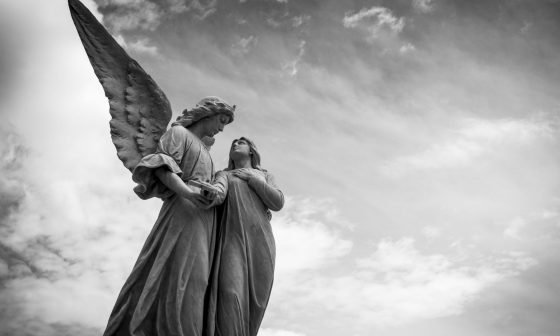
A woman who cannot have children receives a visit from the angel of the Lord. She is told that she will give birth to a son. This son will begin to deliver Israel from the Philistines. Even before Samson is conceived, his life has direction.
The instructions given to his mother are careful and specific. She is told that the child will be a Nazirite from the womb. That means he is set apart. There are boundaries. There is purpose. There is a calling before there is any action.
Samson does not choose this calling. It is given to him.
That detail matters. Samson grows up with a gift and a responsibility he did not create for himself. This is often where tension begins in human lives. A person can be chosen, gifted, and empowered, yet still struggle to live wisely with what they have been given.
Judges 13 ends with a simple line. The child grows, and the Lord blesses him. The Spirit of the Lord begins to stir him.
Everything looks hopeful at this point. But the story is only beginning.
A devotional reflection on Samson’s calling
There is something gentle and sobering in the way Samson’s story starts. He is not introduced as a hero. He is introduced as a child with a calling.
This reminds us that calling comes before performance. God’s purposes are not dependent on our maturity. But how we live with that calling still matters deeply.
Many people carry gifts they did not earn. Strength, opportunity, intelligence, influence. These things are not proof of character. They are tools. And tools can be used well or wasted badly.
Samson’s life asks a quiet question. What do we do with what God has placed in our hands?
Judges 14: strength meets impulse
Judges 14 shifts the tone. Samson is no longer a child growing under blessing. He is a young man making his own decisions.
The chapter opens with Samson going down to Timnah, a Philistine town. There, he sees a woman he wants to marry. He tells his parents plainly that he wants her, and he wants her now.
His parents are concerned. They question his choice. Not because marriage is wrong, but because of where his desire is leading him. Samson does not argue thoughtfully. He insists.
This moment sets a pattern that repeats through his life. Samson is driven by what he sees and what he feels in the moment. His strength does not slow him down. It seems to make him more confident in his impulses.
On the way to Timnah, Samson kills a lion with his bare hands. Later, he turns that moment into a riddle for entertainment. Even his victories become casual stories.
God is still working in the background. The Bible makes that clear. But Samson himself is not paying attention to the deeper meaning of his actions.
Judges 14 shows us a man with extraordinary power and very little restraint.
A devotional reflection on early choices
Samson’s early adulthood feels familiar. He is not choosing evil for its own sake. He is choosing quickly. He is reacting. He is letting desire lead.
Many lives drift this way, not through rebellion, but through impatience. Small decisions. Unchecked wants. A sense of invincibility.
Samson’s strength does not protect him from consequences. It only delays them.
This part of his story reminds us that wisdom is not automatic. Even when God is present, we still have to listen.
Why reading Samson slowly matters
It is tempting to jump ahead in Samson’s story. Most people remember the ending. The collapse. The dramatic prayer. But Judges does not rush there.
The Bible shows us the steps along the way. The ignored warnings. The repeated patterns. The growing distance between calling and character.
Reading Judges 13 and 14 together helps us see that Samson’s fall did not happen in one moment. It unfolded over time.
That is often how spiritual decline works. Not with one loud decision, but with many quiet ones.
Judges 15: when strength is fueled by anger
Judges 15 continues the story without softening it. By now, Samson’s life is marked by tension. What began as personal desire has turned into open conflict. And the driving force behind his actions is no longer just impulse. It is anger.
The chapter opens with Samson returning to his wife, only to discover that she has been given to another man. The situation is humiliating and painful. But instead of stepping back, Samson reacts. His response is immediate and destructive.
He sets fields on fire. Crops are destroyed. Livelihoods are lost. Violence escalates on both sides.
This part of Samson’s story is uncomfortable because it shows how easily strength can become a weapon when it is guided by wounded pride. Samson is not acting as a deliverer in the way we might expect. He is acting as a man who feels wronged and refuses to let it go.
Yet even here, the Bible shows that God is still working. The Philistines tighten their control. Fear spreads. And Israel, instead of rallying around Samson, turns against him. They bind him and hand him over.
This is one of the most striking moments in Judges 15. Samson, chosen to help Israel, is handed over by his own people. They are afraid of the consequences that come with his presence. Peace, even under oppression, feels safer to them than confrontation.
When Samson breaks free and defeats his enemies, the victory is real. But it is not peaceful. It is loud, violent, and exhausting.
At the end of the chapter, Samson cries out to God—not in confidence, but in desperation. He is thirsty. He is drained. For the first time, his strength does not feel endless.
God responds. Water comes. Samson revives.
But even this answered prayer does not change his direction. The cycle continues.
A devotional reflection on anger and exhaustion
Judges 15 reveals something important. Anger can feel powerful, but it always costs more than it gives.
Samson’s victories come from rage and reaction. They are real, but they leave him empty. His cry to God is not the cry of a man at peace. It is the cry of someone who has pushed himself too far.
Many people live this way quietly. They keep going. They keep reacting. They rely on their own strength until they suddenly realize they are empty.
God answers Samson’s prayer for water. But water alone does not heal a soul shaped by constant conflict.
Strength needs direction. Without it, even victory becomes tiring.
Judges 16: a slow and painful unraveling
Judges 16 is often remembered for one name: Delilah. But the chapter does not begin with her. It begins with Samson visiting Gaza and placing himself in danger again.
This matters. Samson’s fall does not start with Delilah. It starts with familiarity with risk. He has survived close calls before. His strength has carried him through. He believes it will always do so.
When Delilah enters the story, she does not overpower Samson. She wears him down. She asks. She presses. She persists.
Samson plays with the truth. He gives partial answers. He treats his calling lightly. Each time he moves closer to revealing what should have been guarded.
This is one of the quiet warnings in Samson’s story. The greatest losses often come from repeated exposure, not sudden betrayal.
Eventually, Samson tells her everything. Not because he is forced, but because he is tired. He trusts the wrong voice. He lowers the last boundary.
When his hair is cut, the Bible says something devastatingly simple. He does not know that the Lord has left him.
That sentence deserves to be read slowly.
Samson still looks the same. He still feels the same. But something essential is gone. His strength no longer answers when he calls on it.
He is captured. His eyes are taken. He is mocked. The man who once terrified nations is now led by a child.
A devotional reflection on slow compromise
Samson’s fall is not sudden. It is gradual.
He crosses lines one by one. He grows used to surviving danger. He assumes strength will always be there.
This part of the story speaks quietly but clearly. Spiritual loss often goes unnoticed at first. There is no alarm. No announcement. Just a growing distance that only becomes clear when we reach for strength that is no longer there.
Samson did not lose his calling in one night. He wore it down.
And yet, the story does not end there.
The final prayer of Samson
Near the end of Judges 16, Samson is brought into a public gathering. He is meant to be entertainment. A reminder of victory for his enemies.
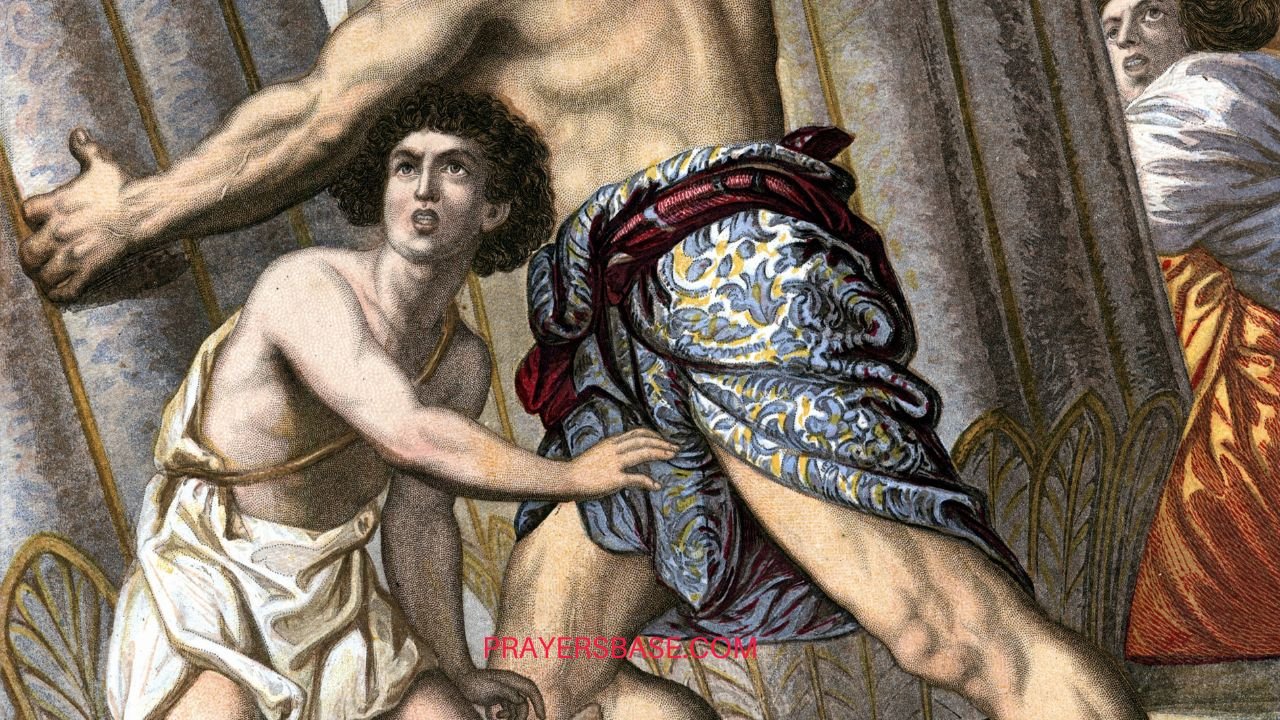
Blind and weak, Samson asks to be placed near the pillars. Then he prays.
This prayer is short. It is not polished. It does not explain itself. It is a cry from someone who has nothing left to prove.
God hears him.
Strength returns, not for a lifetime, but for a moment. And in that moment, Samson fulfills what he was called to begin. The deliverance is costly. His life ends with the act.
Samson’s story closes not with triumph, but with mercy.
What Samson’s story teaches when read devotionally
When people read the story of Samson, it is easy to focus on the dramatic moments. The strength. The conflicts. The fall. But when the story is read slowly, as a whole, it speaks in quieter ways.
Samson’s life is not written to impress us. It is written to warn us, steady us, and remind us how patient God can be with flawed people.
One of the clearest lessons is that gifts and character are not the same thing. Samson was gifted from birth. His strength was real, and it was from God. But strength did not make his choices wise. It only made the consequences louder.
Many people confuse ability with approval. Samson’s story gently separates the two. God can work through a person while that person is still making poor decisions. That does not mean those decisions are harmless.
Another lesson is that private habits shape public outcomes. Samson’s downfall did not begin on a public stage. It began in private moments where he treated boundaries lightly. Over time, those moments formed a pattern.
This is often how spiritual drift happens. Not through open rebellion, but through familiarity with compromise.
Samson’s life also teaches that pain does not always soften a heart. Sometimes it hardens it first. Judges 15 shows a man driven by anger and reaction. His strength grows, but so does his exhaustion.
And yet, perhaps the most important devotional truth in Samson’s story is this: God listens even when a life is broken.
Samson’s final prayer is not confident or eloquent. It is honest. And God answers it. Not because Samson deserved a second chance, but because mercy is part of God’s nature.
That does not make Samson’s life a success story. But it does make it a true one.
Why the Bible does not hide Samson’s failures
Some people struggle with Samson’s story because it feels uncomfortable. Why would Scripture include such a flawed figure?
The Bible does not sanitize its people. It tells the truth about them. That honesty is part of what makes it trustworthy.
Samson is not presented as an example to copy. He is presented as a life to learn from. His failures are not hidden because they are part of the lesson.
If the Bible only recorded perfect obedience, many readers would feel excluded. Samson’s story reminds us that God works in a world full of unfinished people.
It also reminds us that consequences are real. Mercy does not erase them. Samson’s final victory comes at the cost of his life.
Grace is not cheap. But it is still grace.
Common questions people ask about Samson
Many readers searching for where Samson’s story is in the Bible also have practical questions. These questions often come from genuine curiosity, not doubt. Taking time to answer them helps ground the story.
Was Samson a real person in the Bible?
Samson is presented in Scripture as a historical figure within Israel’s history. His story is told as narrative, not parable or poetry.
Was Samson a judge or a prophet?
Samson is identified as a judge of Israel. He was not a prophet in the traditional sense. His role was tied to deliverance, not teaching.
Who were Samson’s parents?
The Bible names Samson’s father as Manoah. His mother is not named, but she plays an important role early in the story through her obedience and faith.
Where did Samson live?
Samson lived in the region between Israel and Philistine territory. His life unfolded along a border, both geographically and spiritually.
What was Samson’s weakness?
Samson’s greatest weakness was not Delilah. It was his lack of self-control and discernment. Delilah revealed what was already there.
Why was Samson’s hair important?
Samson’s hair symbolized his Nazirite vow and his separation to God. The hair itself was not magical, but it represented obedience.
Did God forgive Samson?
The Bible does not use that exact phrase, but God’s response to Samson’s final prayer strongly suggests mercy. God listened. God acted. That alone speaks clearly.
Reading Samson’s story with honesty
Samson’s story invites readers to be honest with themselves. Not fearful, not defensive, but honest.
It asks questions like: What gifts have I been given?
How do I treat boundaries?
Do I rely on strength more than wisdom?
Am I listening, or just reacting?
What would my prayers sound like if I stopped pretending?
These are not questions meant to shame. They are meant to steady the heart.
Samson’s life shows us that God’s patience is long, but time is not endless. Choices matter. Direction matters.
And yet, even at the end, when so much has been lost, God still listens.
That truth does not excuse waste. But it does offer hope.
Where Samson’s story leaves us today
By the time Samson’s story ends, there is no celebration. There is no long speech. There is only silence and reflection.
That is fitting.
Samson’s life does not close with answers neatly tied together. It closes with weight. With loss. With a sense that something important was given and only partly fulfilled.
And yet, even in that weight, there is meaning.
Samson’s story reminds us that God works through real people, not ideal ones. People who hesitate. People who react poorly. People who ignore warnings longer than they should. His life shows us that calling is not fragile, but people are.
There is also a quiet warning here. Strength can hide weakness for a long time. Ability can delay consequences, but it cannot cancel them. When wisdom is ignored, even great gifts eventually fail.
Still, the story does not leave us in despair.
Samson’s final prayer matters. Not because it was heroic, but because it was honest. There was no bargaining in it. No promises. Just a man, broken and aware, calling out one last time.
God listened.
That does not mean Samson’s choices were undone. His life ended with real loss. But his prayer was not ignored. And that tells us something important about God’s character.
God does not wait for perfect words. He listens for truth.
For readers today, that may be the most important takeaway. You may recognize parts of yourself in Samson. Not the strength, perhaps, but the drifting. The compromises. The moments where you assumed things would always work out.
Samson’s story gently tells us not to wait until everything collapses before we pray. But it also tells us that if we do find ourselves there, prayer is still possible.
My Final Words
If you came to this article simply asking where the story of Samson is in the Bible, the answer is clear. It is found in Judges chapters 13 through 16.
But if you stay with the story long enough, it becomes more than a location. It becomes a mirror.
It reminds us that faith is not proven by strength alone. It is shaped by obedience, restraint, and humility. And when those are missing, even the strongest life can feel empty.
At the same time, Samson’s story reassures us that God’s mercy does not disappear when we fail. It does not excuse the failure. But it meets us honestly within it.
That balance matters. Truth and mercy, held together.