
Have you ever sat across from your spouse, maybe in the middle of an argument, maybe just in tired silence, and wondered why marriage, something God himself called “good,” can sometimes feel like the hardest assignment of your life?
If you have, you are not alone. Every couple, no matter how strong, hits seasons where love feels more like discipline than delight. The good news is that God did not leave us to figure marriage out on our own. The marriage lessons from the Bible are not abstract theology tucked away for theologians. They are real, practical, sometimes uncomfortable truths drawn from real couples who loved deeply, failed honestly, and found grace on the other side.
In this post, we’re walking through 20 marriage lessons from the Bible that cover nearly every area of married life, from the foundation of your covenant, to conflict and forgiveness, to intimacy, finances, and prayer. Whether you’ve been married three months or thirty years, these truths were written for exactly where you are right now.
- What the Bible actually says marriage is for (it’s not what culture tells you)
- Six real biblical couples, and what their marriages got right and wrong
- Practical lessons on communication, conflict, and forgiveness
- What scripture says about faithfulness, intimacy, and guarding your marriage
- How prayer, finances, and shared purpose hold a marriage together long-term
The Foundation: What Marriage Actually Is
Before we look at conflict, intimacy, or communication, we have to start in the right place. Most marriage struggles trace back to a wrong idea about what marriage even is. Get the foundation right, and everything else has somewhere solid to stand. 
1. Marriage was God’s idea, not culture’s
Long before weddings, governments, or relationship books, God created marriage in a garden. “The Lord God said, It is not good that the man should be alone” (Genesis 2:18). Marriage wasn’t humanity’s invention to solve loneliness. It was God’s gift, designed before sin ever entered the world. That changes everything about how we treat it. It’s not a social trend to be redefined by whoever shouts loudest; it’s a sacred design with a divine author.
Note: When you feel tempted to measure your marriage against culture’s shifting standards, return to Genesis 2. Ask, “What did God design this for?” instead of “What does everyone else’s marriage look like?”
2. It’s a covenant, not a contract
Malachi 2:14 calls a wife “thy companion, and the wife of thy covenant.” A contract is broken the moment one party stops performing. A covenant holds even when both people are struggling, because it was never about performance in the first place, it was about commitment. This is why God says in Malachi 2:16 that He hates divorce: not because He’s indifferent to pain, but because He knows what a broken covenant costs everyone it touches.
Practical application: Stop asking, “Is this marriage still working for me?” and start asking, “How do we work through this together?” That single shift in language changes how you approach every disagreement.
3. Leaving and cleaving comes before becoming one
“Therefore shall a man leave his father and his mother, and shall cleave unto his wife: and they shall be one flesh” (Genesis 2:24). Notice the order. Leaving comes first, a deliberate break from old dependencies, old loyalties, even old habits that don’t belong in your marriage anymore. Cleaving is next, choosing your spouse above every other voice in your life. Only then does “becoming one” happen. Skip the leaving, and the cleaving never gets the chance to take root.
Practical application: Identify one loyalty that still outranks your spouse in practice, whether that’s a parent, a friend group, an old habit, or even a career ambition. Naming it is the first step toward reordering it.
4. Marriage was designed to shape your character, not just your happiness
Our culture sells marriage as a happiness delivery system. The Bible tells a different story. “For whom he did foreknow, he also did predestinate to be conformed to the image of his Son” (Romans 8:29). God uses marriage, closer than almost any other relationship, to expose your selfishness, your pride, your impatience, and shape you into someone more like Christ. Your spouse will reveal blind spots no one else can reach. That’s not a flaw in your marriage. That’s the design working exactly as intended.
Practical application: Next time your spouse points out a flaw that stings, pause before defending yourself. Ask God whether there’s truth in it He’s trying to use for your growth.
Lessons from Real Biblical Marriages
Scripture doesn’t give us a theory of marriage and leave it there. It gives us real couples, some who modeled faithfulness beautifully, and some whose mistakes are recorded so we don’t have to repeat them. Both kinds of stories teach us something.

5. Adam and Eve: blame breaks intimacy faster than failure does
When God confronted Adam after the fall, his answer was immediate: “The woman whom thou gavest to be with me, she gave me of the tree, and I did eat” (Genesis 3:12). The failure was bad enough. The blame is what fractured the relationship. Every couple sins against each other eventually. The lesson isn’t that you’ll never fail your spouse, it’s that how you respond to failure determines whether intimacy survives it.
Practical application: The next time something goes wrong in your home, catch yourself before the sentence starts with “you.” Try “I” instead, even when part of the fault genuinely belongs to your spouse.
6. Abraham and Sarah: God’s promises are worth the wait
Abraham and Sarah waited 25 years for the child God promised them. Along the way, fear and impatience led to real mistakes, Abraham twice presented Sarah as his sister out of fear (Genesis 12:10-20), and they tried to “help” God’s promise along through Hagar (Genesis 16:1-4). Yet Hebrews 11:11 still credits Sarah’s faith: she “received strength to conceive seed… when she was past age, because she judged him faithful who had promised.” Their marriage shows that waiting on God together, even imperfectly, is better than taking matters into your own hands.
Practical application: Name the one area where you and your spouse are tempted to “help God along” out of impatience or fear. Talk honestly about what waiting well would look like instead.
7. Jacob, Leah, and Rachel: favoritism poisons a household
Jacob loved Rachel but was given Leah first, and scripture records plainly that he “loved also Rachel more than Leah” (Genesis 29:30). The result was decades of rivalry, resentment, and pain that rippled into the next generation through their children. This is a hard but necessary lesson: comparison and favoritism, even unintentional, create wounds that outlast the original circumstance. A healthy marriage refuses to let one person’s needs or affections be treated as secondary.
Practical application: If you have children, watch for ways you might unconsciously compare your spouse to an “ideal” you carry in your head. Speak appreciation for who they actually are, out loud, regularly.
8. Ruth and Boaz: integrity is more attractive than charm
Ruth’s loyalty to Naomi and her willingness to work humbly in the fields caught Boaz’s attention long before romance entered the picture, “all the city of my people doth know that thou art a virtuous woman” (Ruth 3:11). Boaz, in turn, treated Ruth with honor and integrity rather than taking advantage of her vulnerable position. Their story teaches that the qualities worth marrying, and the qualities worth becoming, are character, loyalty, and integrity, not charisma.
What to do: If you’re single and reading this, let Ruth and Boaz reshape your checklist. If you’re married, thank your spouse today for one specific act of integrity you’ve watched them choose.
9. Hosea and Gomer: covenant love keeps choosing
God instructed the prophet Hosea to marry Gomer, knowing she would be unfaithful, as a living picture of God’s covenant love for an unfaithful Israel. “Then said the Lord unto me, Go yet, love a woman… so I bought her” (Hosea 3:1-2). This is one of the most striking pictures of covenant faithfulness in scripture: choosing to keep loving when staying is hard. It’s not a model for every situation, but it reveals the depth of God’s own commitment, and the kind of grace marriage sometimes calls us toward.
Practical application: If you’re walking through betrayal in your own marriage, seek wise, godly counsel before deciding what faithfulness looks like in your specific situation. Hosea’s story is a picture of God’s heart, not a one-size-fits-all instruction.
10. Priscilla and Aquila: shared purpose multiplies a marriage
This couple is mentioned six times in the New Testament, always together, always serving. They built their home, their trade, and their ministry around a shared faith, even risking their lives for Paul (Romans 16:3-4) and teaching Apollos together (Acts 18:26). Their marriage wasn’t just a private arrangement; it was their ministry. Couples who find a shared purpose bigger than themselves tend to build marriages that outlast convenience.
Application: Talk with your spouse this week about one cause, ministry, or shared goal you could pursue together, not just side by side, but as a genuine team.
See also: 10 Bible Stories About Kindness: Inspiring Tales of Compassion and Love
Communication, Conflict & Forgiveness
No marriage survives on good intentions alone. Scripture is remarkably practical about the mechanics of how two imperfect people stay connected through disagreement.
11. Love is a daily decision, not just a feeling
Perhaps no passage has shaped more marriages, and been forgotten by more couples by the first argument, than 1 Corinthians 13. “Love is patient, love is kind… it is not easily provoked, thinketh no evil… beareth all things, believeth all things, hopeth all things, endureth all things” (1 Corinthians 13:4-7). Notice what this doesn’t say: it doesn’t say love feels a certain way. It describes love as something you do, deliberately, especially on the days it doesn’t come naturally.
Practical application: Read 1 Corinthians 13:4-7 together as a couple and replace the word “love” with both your names. Let it sting a little, then let it guide your next decision.
12. Your words are either building or slowly tearing down your home
“Death and life are in the power of the tongue” (Proverbs 18:21). Ephesians 4:29 takes it further: “Let no corrupt communication proceed out of your mouth, but that which is good to the use of edifying.” Every conversation in your marriage is doing one of two things: building your spouse up or wearing them down. Sarcasm, contempt, and careless words accumulate quietly until a marriage feels hollow. Kind, intentional words do the opposite.
Practical application: For one week, pay attention to your tone before your words. A kind tone with an honest disagreement does far less damage than a harsh tone with a polite sentence.
13. Don’t let unresolved anger become a foothold
“Be ye angry, and sin not: let not the sun go down upon your wrath: neither give place to the devil” (Ephesians 4:26-27). Anger itself isn’t condemned here, every couple gets angry sometimes. What scripture warns against is letting it sit, fester, and harden into something the enemy can use to drive a wedge between you. Talk it through. Resolve what you can. Don’t let silence do the talking for days at a time.
Practical application: Agree on a simple house rule together: disagreements get addressed before bedtime whenever possible, even if the full resolution has to wait until morning.
14. Forgiveness isn’t optional, it’s the maintenance plan
“Forbearing one another, and forgiving one another… even as Christ forgave you, so also do ye” (Colossians 3:13). No marriage survives long without forgiveness, because no marriage survives long without two people who occasionally hurt each other. This isn’t about pretending the hurt didn’t happen. It’s choosing, repeatedly, not to keep score, because the alternative is a marriage slowly buried under an invoice neither of you can ever fully pay.
Practical application: If you’re holding onto an old offense you haven’t named out loud, bring it into the light gently and ask for what you actually need, closure, an apology, or simply to be heard.
Faithfulness, Intimacy & Trust
The Bible takes the protection of marriage seriously, not out of prudishness, but because it understands how easily trust can erode and how deeply betrayal wounds.

15. Guard your heart and your marriage bed deliberately
“Marriage is honourable in all, and the bed undefiled” (Hebrews 13:4). Proverbs 4:23 adds, “Keep thy heart with all diligence; for out of it are the issues of life.” Faithfulness isn’t passive, it’s something you actively guard. That means being honest about what you let your eyes linger on, who you confide in, and what you allow yourself to fantasize about. Small compromises rarely stay small.
Practical application: Build one concrete safeguard into your life this month, whether that’s accountability with a trusted friend, honesty about your media habits, or simply telling your spouse the truth before they have to ask.
16. Emotional affairs start long before physical ones do
Most betrayal doesn’t begin with a dramatic decision. It begins with a slow drift. An emotional intimacy shared with someone outside the marriage. A vulnerability you’re no longer offering your spouse but are offering someone else. A private fantasy entertained instead of named and uprooted. Scripture’s call to guard your heart applies here directly: catch the small drift before it becomes a canyon.
Practical application: Ask yourself honestly: is there anyone I’m sharing more of my heart with than I’m sharing with my spouse right now? If so, redirect that vulnerability home.
17. Physical intimacy is a mutual gift, not a bargaining chip
“Let the husband render unto the wife due benevolence… defraud ye not one the other” (1 Corinthians 7:3-5). Paul is strikingly direct: physical intimacy in marriage belongs mutually to both spouses. It was never meant to be used as a reward for good behavior or withheld as punishment. Treated as a gift freely given rather than a transaction, it becomes one of the deepest expressions of “one flesh” the Bible describes.
Practical application: If intimacy has become a source of tension rather than connection in your marriage, talk about it directly and gently rather than letting resentment speak for you instead.
Roles, Resources & Prayer
A marriage isn’t just an emotional bond. It’s also a shared life, a shared home, and a shared spiritual journey. These last few lessons cover the practical glue that holds the rest together.
18. Sacrificial love is the husband’s assignment
“Husbands, love your wives, even as Christ also loved the church, and gave himself for it” (Ephesians 5:25). This is one of the highest standards in all of scripture, not love as long as it’s convenient, but love that gives, sacrifices, and serves first. The same passage calls wives to respect that love in return (Ephesians 5:33), not a one-way demand, but two callings that, lived out together, build a home neither spouse could build alone. A husband who takes his calling seriously sets the emotional temperature for the whole home.
Practical application: Husbands, ask your wife what sacrificial love would look like to her this week, specifically. Wives, tell your husband one way he’s already living this out that you’ve noticed and appreciated.
19. Managing life and money together is a team sport
“The thoughts of the diligent tend only to plenteousness” (Proverbs 21:5). Solomon also reminds us that “two are better than one… for if they fall, the one will lift up his fellow” (Ecclesiastes 4:9-10). Finances are one of the most common sources of marital tension, but scripture frames money management as a partnership, not a power struggle. Budgeting together, being honest about debt and spending, and treating provision as a shared responsibility protects a marriage from one of its most common fault lines.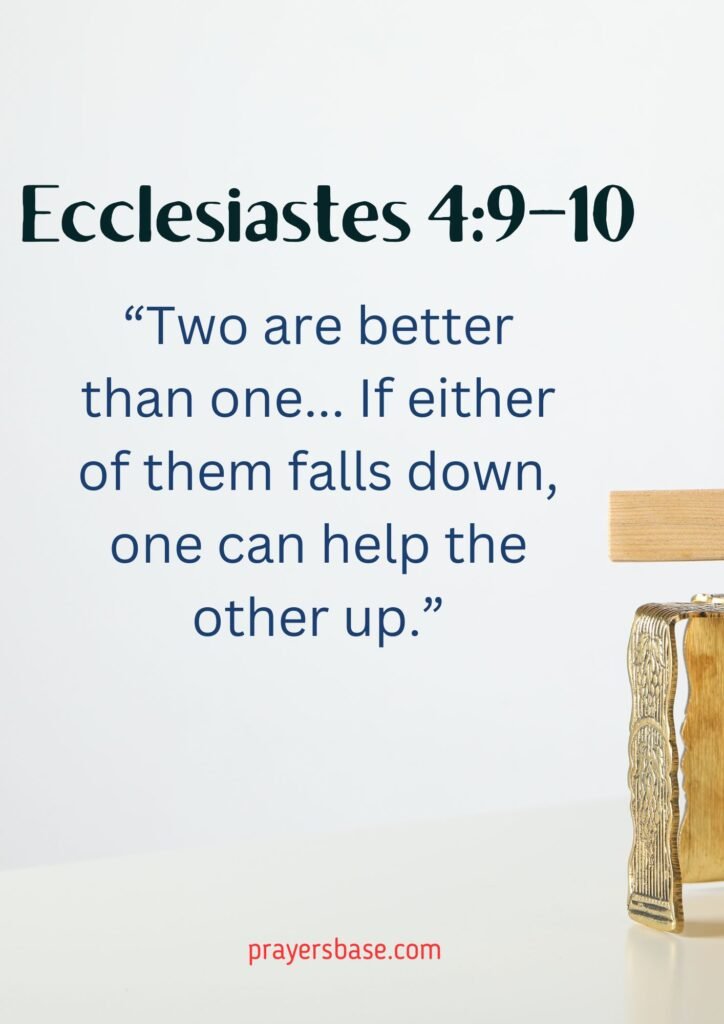
Practical application: Schedule one honest, judgment-free money conversation this month, not to assign blame for past spending, but to agree on where you’re headed together.
20. Prayer is the quiet strength behind every marriage that lasts
Peter instructs husbands to treat their wives with honor, “that your prayers be not hindered” (1 Peter 3:7), a striking reminder that how you treat your spouse and how connected you are to God are not separate issues. Couples who pray together, even briefly and imperfectly, build a shared dependence on God that holds steady when willpower alone runs out. It’s often the simplest habit and the most overlooked one.
Practical application: Start small, one minute of prayer together before bed this week. Consistency matters far more than eloquence. See also: 20 Bible Timeless Lessons for Adults That Will Change Your Life Forever
Frequently Asked Questions About Marriage Lessons from the Bible
What does the Bible say about marriage lessons?
The Bible teaches that marriage is a covenant designed by God for companionship, sanctification, and reflecting Christ’s love for the church. Its core lessons include sacrificial love, forgiveness, faithfulness, honest communication, and treating your spouse with honor and respect through every season.
What biblical couples can we learn marriage lessons from?
Scripture gives us several couples to learn from: Adam and Eve (the cost of blame), Abraham and Sarah (faith through long waiting), Jacob, Leah, and Rachel (the damage of favoritism), Ruth and Boaz (integrity and loyalty), Hosea and Gomer (covenant faithfulness despite betrayal), and Priscilla and Aquila (partnership built on shared purpose).
What is the number one lesson on marriage from the Bible?
If there’s one lesson that underlies all the others, it’s this: marriage is a covenant, not a contract. Genesis 2:24 and Malachi 2:14 both frame marriage as a binding commitment that holds even when it’s difficult, not an agreement that dissolves the moment one person stops feeling satisfied.
How does the Bible say to handle conflict in marriage?
Ephesians 4:26-27 instructs couples not to let anger linger past the day, and Colossians 3:13 calls for ongoing forgiveness rather than keeping score. Practically, this means addressing disagreements honestly and quickly, choosing words that build rather than wound (Proverbs 18:21), and consistently extending the same grace God has extended to you.
What does the Bible say about marriage when it’s hard?
The Bible never promises an easy marriage. It promises a purposeful one. Romans 8:29 frames difficulty as part of how God shapes character within marriage, while 1 Corinthians 13 reminds couples that love “beareth all things” and “endureth all things.” Hard seasons are not a sign that something has gone wrong with God’s design; they’re often the design doing exactly what it’s meant to do.
Can a struggling marriage be saved according to the Bible?
Yes. Scripture is full of marriages that survived real failure: Abraham and Sarah’s fear-driven mistakes, Jacob’s family’s deep dysfunction, even Hosea and Gomer’s betrayal. The consistent thread is that grace, repentance, and a renewed commitment to the covenant can restore what feels broken. A struggling marriage isn’t a failed one. It’s an invitation to return to the foundation.
Final Thoughts
So, back to that question we started with: why does marriage, something God called good, sometimes feel like the hardest thing you’ve ever done? Maybe because it was never meant to run on willpower alone. It was designed to run on covenant, grace, forgiveness, and daily, deliberate love, the kind only God can sustain in you when your own runs dry.
Whichever of these 20 lessons your marriage needs most right now, you don’t have to apply all of them today. Pick one. Pray about it with your spouse tonight. God who designed marriage in the first place is more than able to help you build one that lasts.
Heavenly Father, thank You for the gift of marriage. Teach us to love sacrificially, forgive quickly, and guard what You have joined together. Where we are weak, be our strength. Where we have drifted, draw us back to each other and to You. In Jesus’ name, Amen.